 On The Desk
A Full Year to Send It Back, and Twelve Weeks That Found Nothing
TinnaRex gives you 365 days to change your mind about five herbs in a two-ounce bottle. I read the return terms first, then the trial of its main herb, and put the two side by side.

This is a paid advertisement. Sponsored by Silver Star Brands, Inc. (Native Remedies).

Malcolm Reeve is the pen name of this desk.
Everything on this page about the bottle comes from the seller's own product page, its published terms, and the customer reviews on that page, all read on September 20, 2026.
The reviewers quoted are real and their words are public on the seller's site.
The small pictures beside three of them are illustrations, not the reviewers.
The still room in an old house was the cold room off the kitchen where things were put by.
Preserves, cordials, vinegars, waters drawn off herbs: everything that had to sit for a while before anybody found out whether it had worked.
I have been thinking about that room all month, because of a bottle and a calendar.
The bottle is small and amber and holds five herbs in glycerin; the calendar is the seller's, and it runs for a full year.
Three hundred and sixty-five days to change your mind.
That is the longest return window I have read on any product page this year, by a wide margin.
Most of the bottles on this desk give you thirty days, or forty-five, or sixty, and several give you nothing once the seal is broken.
So my first question was not what is in the bottle.
It was what a year is actually for.
A seller who gives you a year is telling you something, and it is worth working out what.
It might be confidence, and it might be arithmetic, and on this listing I think it is a little of both.
The bottle is TinnaRex, sold by Native Remedies, a brand of Silver Star Brands, Inc. of Oshkosh, Wisconsin. Five herbs in vegetable glycerin and water, half a milliliter in a quarter cup of water, three times a day.
Here is the arrangement of this page, so you know what you are getting into.
I read the return terms first, line by line, because they are the best thing on the listing and nobody reads them.
Then I read the herb the seller singles out for hearing, and the trial that tested it in more than a thousand people who hear a ringing.
Then the other four herbs, the label's own caution, the missing numbers, and the reviews.
And then the sentence this whole page is built toward, which I will give you now rather than at the end.
A year protects your money. It does not protect your months.
If you have never heard the thing this page is about, it is a thin, high tone that arrives when the room goes quiet.
The dishwasher stops, the television goes off, and there it is, and nobody else in the room can hear it.
About one adult in ten in this country reported it in the past year, in the largest national survey there is. [1]
Roughly four in ten of those people called it a small problem rather than a big one. [1]
It travels with hearing that has slipped a little, and hearing slips for almost everybody eventually.
That is not the thing a bottle is sold for, and it is the first thing worth checking.
That is the room this bottle is sold into, and it is a room full of people who would like an answer that costs forty dollars.
I would like that answer too.
What I found instead was a well-run company, a generous calendar, and a body of evidence that points the other way, and you are owed all three.
Three Hundred and Sixty-Five Days, Read One Line at a Time
Start with the calendar, because the calendar is the reason this page exists.
The seller's terms say it plainly enough.
Try the product for at least thirty days; if you are not completely satisfied, for any reason, send it back within one year for a refund of the price, less shipping.
Read that again with a pencil in your hand, because there are four conditions in it and only one of them is obvious.
The obvious one is the year.
The first condition that is not obvious is the thirty days.
The terms ask you to have actually tried the bottle for a month before you send it back, which is a reasonable ask and is also a month of your year spent.
The second is the containers.
You return all of them, opened and unopened, which means you cannot buy three, use two and return the third for a refund of everything.
The third is the paperwork.
Your name and your invoice or order number go in the box with the bottles, and the seller asks you to request a return authorization before you post it.
The fourth is the shipping.
The refund is the price of the product, and the shipping you paid on the way in is not part of it; the postage on the way back is yours as well.
A year, a month of trying, every container, your order number, and the postage both ways.
None of that is sharp practice.
It is an ordinary, readable, unusually long return policy from a company with a street address in Wisconsin, and I would rather have it than not.
But it is worth being exact about what it covers.
It covers the forty dollars, and it covers them for a very long time.

Here is the arithmetic that made me sit up.
At the dose printed on the same listing, one bottle is a little under forty days.
A year is nine of those bottles.
So the window the seller is offering is nine times longer than the thing it covers, which is either great confidence or a bet that almost nobody posts anything back.
I think it is mostly the second one, and I do not say that as an accusation.
Long windows work for sellers precisely because the longer you give someone, the less likely they are to act.
The honest way to use a year-long window is to read it as a forty-day window with a long tail. Decide at day forty, not at day three hundred.
Fifty-Nine Milliliters, and How Many Mornings That Really Is
Now the number that decides everything else, and it took a pencil and two minutes.
The listing has a line I liked, because it asks the right question: how long will a bottle last?
The answer it prints is "approximately 80 days".
So I did the sum the listing did not.
The directions on the same page say half a milliliter, three times a day, which is one and a half milliliters a day.
The listing calls the bottle 60 milliliters.
Sixty divided by one and a half is forty.
Forty days, not eighty, at the only adult dose the listing prints.
Then I looked at the seller's own photograph of the bottle, and the front panel prints two fluid ounces.
Two fluid ounces is a shade over 59 milliliters, which takes the honest figure down to about thirty-nine mornings.
One bottle is a month and a week of this, and the listing says it is nearly three months.
I do not know where the eighty came from, and I am not going to invent a reason for it.
There is one explanation that fits, and the listing half-supplies it.
The front of the page says the product suits adults and children six and over, but the directions tab gives a dose only for ages ten and over, and a smaller dose for a younger child would stretch a bottle to about eighty days.
If that is the answer, the listing has printed a child's arithmetic under an adult's heading.
That is a small thing, and small things are what a page like this is for.
Put a price on those mornings while we are here.
The seller's single-bottle price on the day I read it was $39.95, which across thirty-nine mornings is a little over a dollar a day.
This page prints that number once and does not rest on it, because the seller sets the price and prices move.
Look at it yourself, and look at the shipping line for your own address, before you click anything.
One bottle is thirty-nine to forty mornings at the printed adult dose, and about a dollar a day. The listing's "approximately 80 days" does not survive the seller's own directions.
The Herb the Seller Points At, and the Twelve Weeks That Answered It
Of the five herbs on the label, the seller singles out one for hearing, and it is worth giving that sentence credit before taking it apart.
The listing says ginkgo "has been researched for its ability to support healthy hearing".
That is true, and it is more than most listings can say about anything they print.

Ginkgo is the fan-leaved tree planted along half the main streets in this country.
Its leaf extract has been sold for the ears and for memory for about forty years, which is long enough for somebody to have run a proper trial.
Somebody did, and it is the largest one there has ever been.
In 2001 the British Medical Journal published a trial of 1,121 adults aged 18 to 70 who heard a stable ringing, half of them taking 50 milligrams of a standardized ginkgo extract three times a day and half taking a dummy, for twelve weeks. [2]
At the end, 34 of the 360 people on the herb said the sound troubled them less.
And 35 of the 360 on the dummy said exactly the same. [2]
Thirty-four on the herb. Thirty-five on the dummy.
That is not a near miss that fell the wrong way.
That is a herb and a placebo doing the same thing in more than a thousand people, and the authors wrote it in one flat sentence: no more effective than placebo. [2]
I want to be fair to the bottle about one thing here, and it cuts both ways.
That trial used a measured, standardized extract at 150 milligrams a day, and this bottle prints no amount of ginkgo at all.
You can read that as a defense, and people do: the trial tested something else, so the trial does not apply.
You can also read it the way I do, which is that the version with a number behind it did nothing, and the version without a number has never been tested.
Neither reading gets you to a reason to buy.
One says the evidence is against it; the other says there is no evidence either way.

Four Trials, Fifteen Hundred People, and the Same Answer
One trial is one trial, so I went looking for the others.
A Cochrane review pooled four trials with 1,543 participants between them.
It found no evidence that ginkgo helps when a ringing is the main complaint. [3]
Cochrane reviews are the boring end of the evidence business and that is their virtue.
They do not run studies; they gather the ones that exist, weigh how well each was run, and report what is left.
The federal agency for complementary health puts the same conclusion in one sentence on its public ginkgo page.
Ginkgo is not helpful for relieving a ringing in the ears. [4]
So that is a single large trial, a pooled review of four, and a government fact sheet, all pointing the same way.
I have written pages where the evidence was thin; this is not thin, and it is not favorable.
While I was there I checked the other thing people buy for their ears, because you will have seen it on the same shelf.
A separate Cochrane review of three trials in 209 adults found no evidence that zinc supplements improve a ringing either. [5]
Two of the things most often sold for this have been tested properly. Neither one worked.
I put the zinc in here for a reason that has nothing to do with this bottle, which contains none.
It shows you what a tested-and-found-wanting result looks like, so you can recognize the shape of one when a listing does not print it.
Ginkgo has been tested for a ringing in 1,121 people and in a pooled review of four trials with 1,543, and found no better than placebo both times. Zinc has been tested in three trials and came out the same way.
What the People Who Look Inside Ears Put in Their Own Guideline
There is a document that settles the question of what the field thinks, and almost nobody selling you anything will point you at it.
In 2014 the American academy of ear, nose and throat specialists published a clinical practice guideline on a persistent, bothersome ringing.
It is the ear, nose and throat specialists' own professional body writing for its own members. [6]
The guideline recommends against ginkgo, melatonin, zinc and other dietary supplements for that ringing. [6]
It is not an oversight or a gap; it is a recommendation, written out, in the negative.
I read the rest of it, because the rest of it is the useful part.
The guideline asks for a prompt, comprehensive hearing examination when the ringing is in one ear only, when it has lasted six months or more, or when it comes with difficulty hearing. [6]
It recommends a hearing-aid evaluation when the test finds the hearing has faded. [6]
And it recommends sound therapy and a form of talking therapy aimed at how much the sound bothers you, which is the part that can actually change. [6]
Every recommendation in it is an appointment. None of them is a bottle.
I am the person writing an advertisement, and I am telling you that the specialists' guideline recommends against the category this advertisement is for.
You should weigh that at least as heavily as anything else on this page.
The same guideline gives the scale of the thing.
It estimates that 10 to 15 percent of adults experience a ringing, and that more than 50 million people in the United States have reported it. [6]
That is a very large number of people and a very small shelf of things that help.
Which is exactly the gap a forty-dollar bottle is designed to sit in.

The Other Four Names on the Label
Five herbs go in the bottle and I have spent four sections on one of them, so here are the rest, in the label's own order.
St. John's wort comes first.
It is the yellow-flowered plant of roadsides and meadows in late June, and it has the longest interaction list of any herb on a shelf, which is the subject of its own section further down.
For the ears it has nothing.
No trial has tested it on hearing or on a ringing, and the seller cites none; it is listed here for the nervous system, which is a traditional claim rather than a measured one.
Rosemary is next, and it is the one you already own.
It is the kitchen herb, and the seller calls it a circulation tonic.
The only trial I can put in front of you gave 28 adults averaging 75 years old a single dose of dried rosemary leaf, about the amount you would put in a roasting tin, and measured how quickly they remembered things. [7]
A much larger dose sent the same measure the other way, which is worth knowing about any plant. [7]
That trial measured memory, not hearing, and it used a weighed dose.
This bottle prints no weight for its rosemary, so even that thin thread does not reach it.

Oatstraw is the fourth.
It is the green stalk and leaf of the common oat, cut before the grain ripens, and it is a different object from the porridge in your cupboard.
The oat trials that exist used a concentrated extract of the milky green seed in capsules, not the dried straw in glycerin.
One found something on thinking tasks in adults aged 35 to 65, [8] and another found nothing at all in adults around 67. [9]
Neither one looked at the ears.
Neither one used this preparation, and neither one used an amount this label prints, because this label prints none.
Four herbs, no hearing trial among them, and not one weight on the panel. That is the plain state of the label, and the seller does not pretend otherwise.
The Vervain With Two Names and One Line
The fifth herb deserves a section of its own, for a reason that has nothing to do with what it does.
The listing calls it "European Blue Vervain".
That name describes two different plants and names neither of them.
Blue vervain is Verbena hastata, a North American plant with tall spikes of small violet-blue flowers, common across the continental United States.
European vervain is Verbena officinalis, a different species native to Europe, with delicate spikes of mauve flowers.
The listing's name is the American one with the European adjective bolted onto the front.
So a man reading the label carefully cannot tell which plant is in his bottle, and there is no panel to check it against.
Two species, one name, no way to tell them apart.
I would not make much of this on its own.
A wild-crafted herb in a five-herb blend is not where I expect precision, and both plants have long, respectable histories as bitter tonics in folk herbalism.
It matters because of what it sits beside.
A listing that mixes up two species and prints no amounts is a listing that has not been read closely by anyone, and this page is an attempt to read it closely.
There is one more thing of that kind on the page, and I will mention it once and move on.
The ingredients tab spells the ginkgo "Gingko", which tells you the same thing the vervain does about how carefully the copy was checked.
The Caution the Label Prints, and What Sits Behind It
This is the section I would read twice if I were you, and it is the one the calendar cannot help with.
The label carries its own caution, in its own words, and it is more specific than most.
Do not use this product together with warfarin or other anticoagulants, and while taking St. John's wort, avoid excessive exposure to sunlight or UV light.
Two of the five herbs stand behind those two lines.
The ginkgo is behind the first: the federal agency for complementary health says ginkgo may raise the chance of bleeding in people taking anything that thins the blood. [4]
St. John's wort is behind both, and it is the more serious of the two.
The same agency states that St. John's wort can interact in dangerous, sometimes life-threatening ways with a variety of everyday medicines, weakening some and amplifying others. [10]
It also says that in large amounts it can cause severe skin reactions after sun exposure. [10]
That is the second half of the label's caution, and the label is right to print it.
I am not going to list what it interacts with on this page.
The list is long, it is in the ingredient guide linked at the foot, and a page like this one is the wrong place to read a list like that.
Here is the whole of my advice on this, and it takes four minutes.
Put everything you take every day into one bag, this bottle included, and carry the bag to a pharmacy counter.
Then say the two names out loud: St. John's wort, and ginkgo.
Those are the words that make the person behind the counter stop and check.
They cannot read a label through a paper bag, and the two herbs in question are exactly the two that a pharmacist will want to hear named.
None of that makes this bottle a dangerous object.
It makes it a real plant extract with real interactions, which is what a page like this is supposed to tell you before you pay rather than after.
The label itself says not to take this with anything that thins the blood, and to stay out of strong sun. Take the bottle and everything else you take to a pharmacy counter before the first half milliliter.

"In Therapeutic Dosage": Five Herbs and Not One Number
Now the omission at the center of the label, and I want to be exact about it rather than indignant.
The ingredients tab lists the five herbs and then says they are present "in therapeutic dosage".
It does not say what that dosage is, for any of them.
There is no supplement facts panel on the listing.
There are no milligrams, no percentages, no standardization figures, and no split between the five.
The only quantity anywhere on the page is the serving: half a milliliter.
Half a milliliter of a five-herb glycerin extract could carry almost any amount of any of them, and nothing on the page narrows it.
One number on the whole label, and it measures the spoon, not the herb.
Read the phrase itself, because it is doing a lot of work.
"In therapeutic dosage" asserts that the amounts are the right ones, without saying what they are, which means it cannot be checked and cannot be wrong.
I do not think that is dishonest. I think it is the oldest convention in herbal manufacture, and it predates the labeling rules by centuries.
But it does put this bottle outside the kind of reading I do for a living.
Here is what the missing numbers cost you, in practical terms.
When the trial of ginkgo used 150 milligrams a day, you could compare any bottle against it by turning the bottle around.
You cannot do that here.
There is nothing to compare, in either direction, and a bottle that cannot be compared cannot be defended either.
One more word that is missing, and it is the one I look for first.
Standardized means a maker states a percentage of a particular compound in every batch, so that this year's bottle is the same object as last year's.
The trial used a standardized extract. [2]
This label does not use the word anywhere, for any of the five herbs.
"In therapeutic dosage" is not a number: no panel, no milligrams, no standardization and no split between five herbs. The only measured thing on the page is the half-milliliter serving.
What the Front of the Label Is Allowed to Say
Turn the bottle around to the front, because the front is a different document from the back.
The front says the product is an herbal supplement for healthy ears and clear, undisturbed hearing.*
That sentence carries an asterisk, and the asterisk carries the standard line that the Food and Drug Administration has not evaluated it.
That is not a loophole and it is not a scandal.
It is the law that every supplement sold in this country works under, and the asterisk is the seam in it.
A supplement may say it supports a normal function of the body.
It may not say it acts on a named condition, and the difference between those two sentences is the entire regulatory architecture of that shelf.
So read the front panel as what it is: a statement of terrain, not a statement of result.
"Supports healthy ears and clear hearing" is a claim about the category the bottle belongs to.
It is not a claim that anything will get quieter, and the seller has not made one.
I give the maker credit for staying on the right side of that line on the bottle itself.
Where the line gets crossed is not on the label; it is in the sales copy two tabs away, which is the next section.
The other bullets on the listing run in the same register.
Supports the structures of the ear, supports sound conduction, encourages inner ear balance, supports the nervous system, encourages circulation.
Every one of them is a support claim with an asterisk, and not one of them is measurable from a chair.
That is not a criticism of this bottle in particular; it is a description of the entire aisle.
Two Sentences on the Listing the Label Contradicts
Now the part where the listing and the label do not agree with each other, which is a thing worth showing you once.
Elsewhere on the same product page, the sales copy describes the product as entirely without unwanted effects, and as an approach that is completely reliable.
I am paraphrasing deliberately, because I do not repeat that sort of sentence even to quote it.
Two tabs away, the label says not to take the bottle with anything that thins the blood, and to keep out of strong sun.
Both sentences are on the same listing, written by the same seller, about the same object.
When a page tells you a product has no unwanted effects and then prints a caution about anticoagulants and sunlight, believe the caution.
The same page also suggests pairing this bottle with a second product of the seller's.
I mention it only so you recognize the move when you see it, and I do not repeat the recommendation.
None of this makes Silver Star Brands an unusual company.
Sales copy runs warm and labels run cold, on almost every product page in this category, and the cold one is the one with the legal department behind it.
The label's caution and the sales copy on the same page say opposite things about unwanted effects. The label is the document that counts.
The Quarter Cup: What Taking It Actually Looks Like
Enough about documents. Here is the thing itself, three times a day.
You draw half a milliliter with the glass tube in the cap, squeeze it into a quarter cup of water, and drink it.
The listing allows juice or milk instead of water, and asks you to dilute it either way.
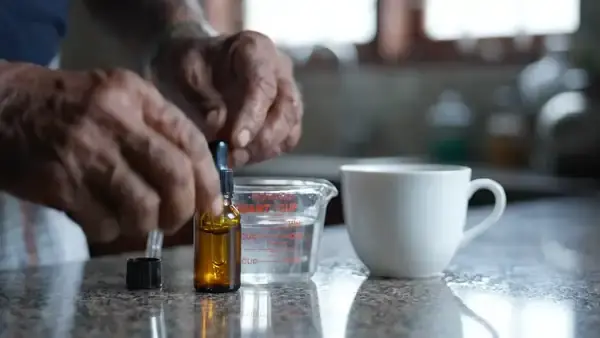
The base is vegetable glycerin and deionized water, with no alcohol in it.
Glycerin is a thick, faintly sweet syrup, and it is why this extract tastes and pours the way it does.
That matters more than it sounds on a page written for men over 55.
A great many herb bottles carry their extracts in alcohol, and this one is one fewer thing to count in an evening.
The listing also says the product contains no gluten and no lactose, and that it suits vegetarians.
Those are checkable statements about what is not in the bottle, and they are worth more than most of what is printed on a front panel.
Three times a day is the part people underestimate.
Breakfast is easy, bedtime is easy, and the one in the middle is the one that is missed, which is the reason most of these bottles last longer than they should.
Pick the three hours before the first day, and write them on the calendar.
The listing says two honest things about what to expect, and I want to quote both.
It says to use it regularly for the best result, and that people differ widely in their response times: some may feel something within days and for others it may take longer.
That second sentence is doing something specific, and it is worth naming.
A statement that a result may take any amount of time is a statement that cannot be disappointed, which is precisely why a fixed date on a calendar is worth more than any promise.
Sixteen Reviews, Four I Could Print, and the One Star I Kept
The seller's page carries sixteen customer reviews with an average of 4.1 stars.
The distribution is worth having in front of you, because an average hides it.
Nine of the sixteen are at five stars, three at four, two at three and two at one.
I read all sixteen across both pages of the widget, and I could not print most of them.
You are owed the reason, because which reviews a page shows you is the whole game.
Nine of them either name the condition, which this page does not print, or say the bottle stopped the sound completely.
That second claim is one the trial in the middle of this page does not support, and I am not going to relay it.
Two more say nothing about the bottle at all.
One had not opened it yet, and one was praising the store rather than the product.
That leaves four, and I have kept all four, including the single star, on purpose.
A man who paid for a bottle and got nothing from it has earned the same space here as a man who paid and liked it.
Three of the four carry the seller's mark of a confirmed purchase and one does not.
Dorothy R's review names the condition in its first sentence, which this page does not print; her second sentence is quoted exactly as she wrote it.
The others are quoted whole, typographical slips and all.
The small pictures beside three of them are illustrations, not the reviewers.

seemed to mute the noise, somewhat

I can tell the difference if I miss taking it for a few days.

Easy to use, mu dad is happy
Have used half a bottle and still have buzzing in my ears. No change in level.
Read those the way I did, one at a time and slowly.
Raphael's "somewhat" is the most careful word on the seller's entire page, and he gave the bottle four stars while writing it.
Dorothy's sentence is about a habit rather than a measurement.
Noticing a difference when you skip a few days is a real experience and it is also what a habit feels like when it stops.
Irene bought it for her father and reports that he is happy, which is a kind thing to write and is not evidence about anything.
It is the shortest review in the pile and the only one that is about somebody else.
And the single star used half a bottle, which at the printed dose is about twenty mornings, and heard no change.
That is exactly what the 1,121-person trial would have predicted, and he is the only person in the pile who told me what nothing feels like. [2]
Nobody I kept describes a result. Two describe something modest, one describes a habit, one describes nothing, and the honest reading sits between them.
One word about the 4.1 itself, since it is the number the page leads with.
An average of sixteen opinions measures how sixteen people felt about a purchase, which is a real thing and a different thing from whether five herbs did anything.

What a Year Cannot Buy Back
Here is the sentence this page has been walking toward since the first paragraph.
A year-long return window is a guard on your money, and it is a good one.
Post the bottles back with your order number and the forty dollars comes home, less the shipping.
It is not a guard on your months.
The months you spend taking something three times a day are gone whether or not the money comes back.
The calendar refunds the price. It does not refund the year.
That is the real cost of a long window, and it is the reason sellers like them.
A generous calendar makes waiting feel like it costs nothing, and waiting is the one thing that always costs something.
There is a version of this that is genuinely good news, though, and I want to end the section on it.
Because the window is a year and a bottle is forty days, you can run a proper, dated, honest test and still have three hundred days of margin.
That is a better position than almost any other bottle on this desk offers.
Sixty days on a supplement that lasts thirty is a squeeze; a year on a bottle that lasts forty is room to be careful.
So use the room.
Buy one bottle, mark the last morning on a calendar the day it arrives, and decide on that morning rather than on some morning in April.
The Cheaper Things to Rule Out First
Before any of this, there is a conversation I have with every man who asks me about a bottle, and it costs nothing.
The first thing is the room itself.
A tone that only arrives when the house is silent is a tone competing with nothing, and the oldest advice for it is to stop making the room silent.
A fan, a radio left low, a window open to traffic.
It costs nothing, thousands of people already do it, and it is the only item in this section you can act on tonight.

The second thing is noise, and it is about the ears you will have in ten years rather than tonight.
A motorcycle, a concert, headphones at their loudest: loud for long enough is the one exposure you can still do something about.
Earplugs and distance are the whole of the protection.
In the national survey, a ringing was about three times as common in people with steady loud noise at work. [1]
The third thing is the hearing itself, and it is the one that finds things.
It fades slowly, over years rather than weeks, which is exactly why almost nobody notices it happening to them.
A proper hearing examination is done one ear at a time, in a quiet booth, with calibrated equipment.
It is read against a look inside the ear canal, and it is the only step on this page that can find something that gets dealt with in one visit.
A fan tonight, earplugs in the workshop, and an appointment this month.
The fourth is a question about the coffee, because somebody always asks.
The largest prospective study of caffeine and a ringing followed 65,085 women for eighteen years, and those who drank the most caffeine were somewhat less likely to develop it, not more. [11]
That study was in younger women and it is observational, so it cannot tell you what your own cup is doing.
What it can tell you is that the case against coffee is thinner than the people who tell you to quit it suggest.
I put those four things ahead of the bottle for one reason.
If one of them is your answer, the bottle will look as though it worked, and you will pay for that coincidence for years.
A fan at night, earplugs when it is loud, a hearing examination this month, and no particular reason to give up coffee. Four things that cost almost nothing, all of them ahead of any bottle.
What Actually Has Evidence Behind It
If I only get one useful section, it is this one, and nothing on it is a supplement.
- A proper hearing examination, promptly if the sound is in one ear only, has lasted six months or more, or comes with difficulty hearing. [6]
- A hearing-aid evaluation if the test finds the hearing has faded, which the specialists' guideline recommends in those words. [6]
- Sound therapy, and a form of talking therapy aimed at how much the sound bothers you rather than at the sound itself. [6]
- Protecting the hearing you still have: earplugs and distance whenever it is loud enough that you have to raise your voice.
- Having everything you take looked at by a pharmacist, with this bottle in the bag.
Every one of those is an appointment, a device or a habit.
Not one of them is a forty-dollar bottle, and the guideline that recommends most of them recommends against the category this bottle belongs to. [6]
I am aware of what it means to write that sentence in an advertisement.
You are entitled to know it before you spend anything, and a page that hid it would not be worth your twenty minutes.
Six Things Five Herbs Will Not Do
- They will not come with a trial of themselves. Nobody has ever tested these five herbs together in anybody.
- They will not tell you how much of anything you took. "In therapeutic dosage" is a phrase, not a number.
- They will not undo the result of the twelve-week trial. It ran in 1,121 people and came out even. [2]
- They will not replace a hearing examination, a hearing aid, or a look inside your ear canal.
- They will not last eighty days. At the printed adult dose one bottle is about thirty-nine mornings.
- They will not act on anything a clinician has named. This is a dietary supplement and its own label says so.
If that list irritates you, I would rather you were irritated on this page than on the fortieth morning with an empty bottle and no idea what happened.
If You Do Buy It: One Bottle and Two Dates
If you are going to try it, try it the way you would try anything else: with a beginning, an end, and something written down.
- Buy one bottle, not three. The window covers all of them from the same day, and three bottles spend it on stock.
- Write two dates on a calendar the day it arrives: day one, and day forty. Day forty is when you decide.
- Take it to a pharmacy counter first, with everything else you take, and say the two herb names out loud.
- Pick the three hours before the first half milliliter and keep them. The middle one is the one people miss.
- Dilute it, as the label says, in a quarter cup of water, juice or milk.
- Write one line a day in a notebook. Not better or worse: what the room sounded like at bedtime, and what you had been doing.
- Do not start it in the same week you change anything else. One change at a time, or the notebook tells you nothing.
- On day forty, read your forty lines beside the ten you wrote in the week before you started. That is the only trial of this bottle you will ever get.

Look at that list the way I do.
Seven of the eight things on it cost nothing at all, and the eighth is a notebook.
The notebook is the part men skip, and it is the part that decides whether you learn anything.
Forty lines written at the same hour will tell you more about your own evenings than this page can.
The Man This Bottle Fits, and the Man It Does Not
This is worth a look if:
- You want a long calendar more than you want a tested ingredient, and you know that is the trade you are making.
- You have read the twelve-week trial in this page and are buying anyway, with your eyes open.
- You will take one bottle as a dated test rather than signing up for a delivery every four weeks.
- You will take the bottle to a pharmacy counter and name the two herbs before the first day.
- You would rather have five plants you can name in glycerin than a blend of eleven things you cannot.
- You have already dealt with the fan, the earplugs and the hearing appointment.
Give it a miss if:
- You take anything that thins the blood. The label itself says not to, and that is the end of it.
- You wanted an amount printed beside each herb. There is not one, anywhere, for any of the five.
- You wanted the main herb's trial to be on your side. It was run in 1,121 people and it was not. [2]
- You were counting on a bottle lasting close to three months. At the adult dose it is about thirty-nine mornings.
- You have not yet had your hearing examined. That appointment comes first, and it can find something this cannot.
Where It's Sold, and Who Stands Behind It
The bottle is sold by Silver Star Brands, Inc., trading as Native Remedies, from Oshkosh, Wisconsin, and that is the only place this page sends you.
The company publishes a street address, a telephone number, an email and a returns desk, all on its own pages.
Those are not claims about herbs; they are facts about who you would be dealing with, and I separate the two on purpose every time.
I have read listings this year with no street address anywhere on the site and no telephone number at all.
A company that prints both, and then gives you a year, is not the problem on this page.
The problem on this page is the evidence, and the evidence belongs to the herb rather than to the company.
Those are two different complaints and it is only fair to keep them apart.

Every herb in the bottle, with its plain English name, what the label does and does not print about it, and whatever research exists for it, is written out in the ingredient guide linked at the foot of this page.
That guide also carries the interaction cautions in full, the references, and the disclosures this page is required to make.
One amber bottle, and a year to reconsider it
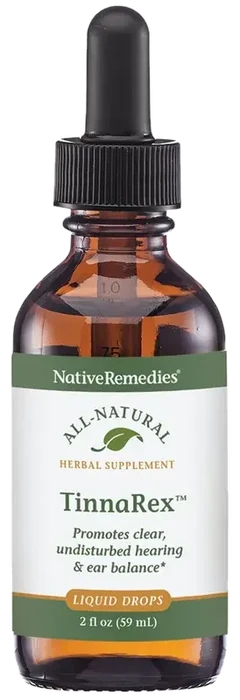
Five herbs in a small bottle of vegetable glycerin and water, half a milliliter in a quarter cup of water three times a day, from a Wisconsin company with a one-year return window.
SEE THE LABEL AND THE TERMSSold by Silver Star Brands, Inc. (Native Remedies), Oshkosh, Wisconsin · 2 fl oz · half a milliliter in a quarter cup of water three times a day · about thirty-nine mornings · a full year to send it back after at least thirty days of use, refund of the price less shipping
What men ask me about the year
Will this bottle quiet the sound?
Nobody can honestly promise that, and I will not. The only large trial of its main herb came out even in 1,121 people. [2]
What does the year actually require?
Trying it for at least thirty days, then posting back all containers within one year with your name and order number. The refund is the price, less shipping.
How long does one bottle last?
About thirty-nine to forty mornings at the printed adult dose of half a milliliter three times a day. The listing's "approximately 80 days" does not match its own directions.
How much of each herb is in it?
The label does not say. It calls the five herbs "in therapeutic dosage" and prints no number for any of them.
Should I ask anyone before I take it?
Yes, if you take anything daily. The label itself says not to use it with anything that thins the blood, and one of the five herbs has a long interaction list. [10]
Is coffee making it louder?
The largest prospective study found the opposite direction in 65,085 women over eighteen years. [11] Caffeine late in the day costs you a night, which is a timing point rather than a reason to quit.
What should I do before any bottle?
Book a hearing examination, one ear at a time. That is the step the specialists' guideline asks for, and the one that can find something fixable. [6]
Who wrote this page, and why?
A writer working for the seller's advertising, under a pen name. We are paid a commission if you buy through the button, which is why every claim here is sourced.
From the Calendar to the Label, in Short
- A two-ounce amber bottle of five herbs in vegetable glycerin and water, sold by Silver Star Brands, Inc. of Oshkosh, Wisconsin as an herbal supplement.
- The return window is a full year, after at least thirty days of use, with all containers and your order number returned and the shipping at your expense.
- At the printed adult dose one bottle is about thirty-nine mornings and a little over a dollar a day, not the "approximately 80 days" the listing prints.
- The herb the seller singles out for hearing is ginkgo, tested in 1,121 people for twelve weeks with 34 of 360 on the herb and 35 of 360 on the dummy. [2]
- A Cochrane review of four trials with 1,543 people found no evidence for it either, [3] and the federal fact sheet says the same in one sentence. [4]
- The specialists' own 2014 guideline recommends against ginkgo, melatonin, zinc and other dietary supplements for a persistent, bothersome ringing. [6]
- Zinc, the other thing sold for this, was tested in three trials with 209 adults and came out the same way. [5]
- The other four herbs have no hearing trial between them; rosemary has one small memory trial [7] and oat has two thinking trials in a different preparation. [8] [9]
- No amount is printed for any of the five herbs, there is no panel, and the word standardized appears nowhere.
- The label says not to take it with anything that thins the blood and to stay out of strong sun; behind those lines are ginkgo [4] and St. John's wort. [10]
- Sixteen reviews averaging 4.1 stars: nine at five, three at four, two at three and two at one. Four are quoted here, including a single star.
- Ahead of any of it: a fan at night, earplugs when it is loud, and a hearing examination. [6]
What a Long Calendar Is Actually Worth
Here is the whole thing in one breath.
This is a well-made herbal extract from a company that prints its address, answers a telephone and gives you the longest return window I have read all year.
It is also a bottle whose main herb has been tested for exactly this, in more than a thousand people, and came out level with a dummy capsule.
Both of those sentences are true at once, and most pages you will read about this bottle print only one of them.
The company is not the problem and the calendar is not the problem; the evidence is the problem, and it belongs to the plant.
A generous seller and a thin case are not a contradiction. They are just two facts.
If you are a man who has already booked the hearing examination, who runs the fan at night, who will take the bottle to a pharmacy counter and name the two herbs, and who will mark day forty on a calendar rather than drifting to April, then a year of margin is worth something real.
Not because of the herbs.
Because you will have bought one clean, dated, forty-morning question, with a long window behind it and a notebook in front of it.
And on the fortieth morning you will know what you actually have, which is more than this page or that listing can hand you.
Buy one bottle. Book the hearing examination first, name the two herbs at the pharmacy counter, write two dates on the calendar, keep a line a day, and decide on day forty rather than in the spring.
The bottle, the terms, and the day you decide
Five herbs in a small bottle of vegetable glycerin and water, half a milliliter in a quarter cup of water three times a day, from a Wisconsin company with a one-year return window.
SEE THE LABEL AND THE TERMSNative Remedies, a brand of Silver Star Brands, Inc. · five herbs in vegetable glycerin and deionized water · about thirty-nine mornings a bottle · one year to send it back, after at least thirty days of use
P.S. If you remember two things from this page, remember the two numbers.
Three hundred and sixty-five, which is the calendar.
And thirty-four against thirty-five, which is the trial. [2]
P.P.S. If the sound is in one ear only, if it arrived suddenly, or if it comes with a drop in hearing, that is an appointment this week rather than a purchase.
A bottle of herbs was never going to answer a question that a hearing examination answers in half an hour.